

19th ISMeC Group – “F. Pulidori” prize
The Ferdinando Pulidori Prize of the International Group for the Thermodynamics of Metal Complexes for outstanding emerging researchers.
The 19th Fernando Pulidori Prize of the International Group for the Thermodynamics of Metal Complexes – (ISMeC Group – Pulidori Prize) will be awarded to a postdoctoral researcher whose research demonstrates excellence within the core scientific themes of the ISMeC Group (ismecgroup.org). Candidates should preferably have conducted research focusing on the thermodynamics and/or kinetics of solution complexation phenomena.
Applicants must be the main author (first, last, corresponding) of at least one original research paper published between 2023 and 2026 or accepted for publication by the application deadline (official acceptance letter will be required).
Eligible candidates must:
- hold a PhD degree in a relevant discipline at the call deadline
- be main author (first, last, corresponding) of at least one publication in a peer-reviewed journal
- be ≤ 35 years old on December 31st, 2026.
- hold a non-permanent research position (e.g. postdoctoral fellow) at a University or a Research Institution.
Application procedure
Applicants must send an email to the Organizing Committee of the ISMEC2026 Congress (ismec2026(at)uniud.it, writing in the subject line: “ISMEC-Pulidori prize application <SURNAME>”) before March 27th, 2026 with the documents detailed below, attached as a single .zip file (max. 20MB).
Documents to submit
- A cover letter explaining the role of the candidate in the work done for the paper presented for evaluation
- A curriculum vitae (EU format) in .pdf: the applicant’s academic career and achievements, a description of the scientific activity highlighting the relevance to the ISMeC topics, international experience, list of articles/presentations/posters/patents, grants
- A copy of the paper selected by the candidate to be presented for evaluation, in PDF format
- A copy of a valid ID
Rewards
The winner will attend ISMEC 2026 with the registration free of charge. In addition, she/he will receive: a certificate, an engraved metal plaque, and a 300 € prize. The winner will be invited to give an invited lecture on the winning paper during the award ceremony. Furthermore, an extended abstract highlighting the winner’s scientific activity will be published in "La Chimica e l’Industria", the official journal of the Italian Chemical Society.
Evaluation
Submitted applications will be evaluated by the International Scientific Committee of ISMEC 2026, considering:
- the scientific level of the paper, its originality and innovative character in the field of thermodynamics and/or kinetics of complexes in solution, the number of authors and the role of the applicant among the authors, her/his contribution to the research;
- the curriculum of the applicant: experience, international profile, papers, grants and conference attendance (especially previous ISMEC Meetings).
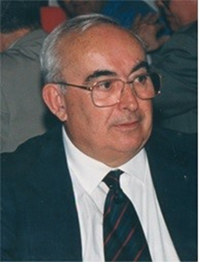
Fernando Pulidori
Fernando Pulidori (1928-2007) was an italian chemist, specialized in thermodynamic chemistry, solution equilibria and solute-solvent interactions of model organic compounds. He graduated in Chemistry at the University of Ferrara, where he also completed his PhD in Physical Chemistry.
Between 1981 and 2000 he was Full Professor of Instrumental Analytical Chemistry of the Faculty of Sciences at the University of Ferrara, Head of the Chemistry Department (1988-1994) and President of the Italian Group of Thermodynamics of Complexes within the Italian Chemical Society. His research interests focused on three main fields:
Solution equilibria: thermodynamic studies on formation of metal complexes with low-molecular weight ligands, stereoselective effects in ternary complex formation and their application in resolution of enantiomer mixtures.
Solute-solvent interactions of model organic compounds in aqueous solutions: hydrophilic-hydrophobic interactions and solvation models.
Dipole moments in apolar solvents; corrosion and inhibition of iron corrosion; adsorption of organic compounds at polarized interfaces and electrical double layer structures; electroreduction mechanisms of organic compounds of environmental interest.